
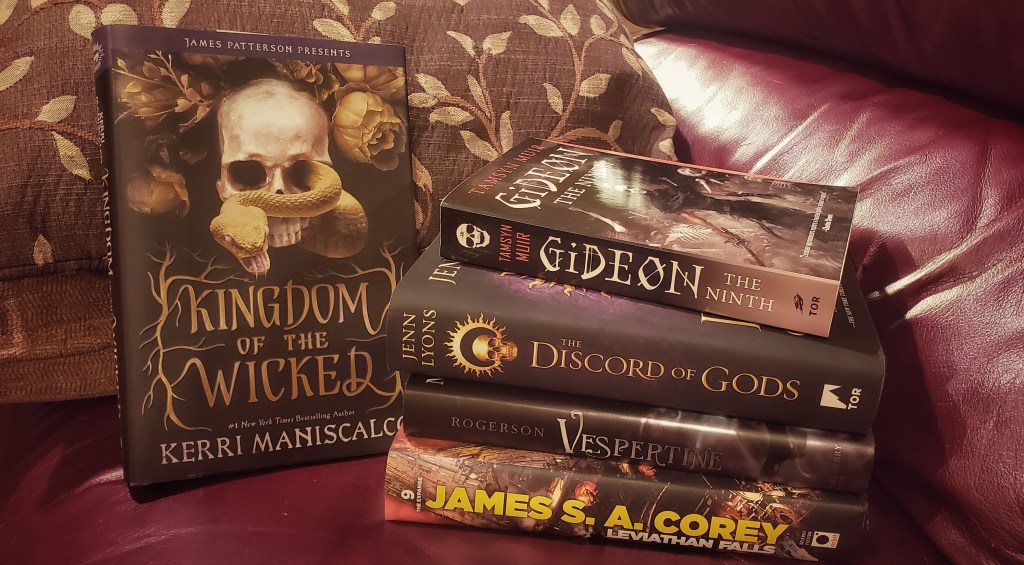
As 2022 comes to a close, I feel like it’s necessary to summarize what may well have been my most active year of reading in quite a while. What started as trying to establish a good habit – of reading for a set amount of time each night – has reignited my love of all things reading and. More recently, it’s also encouraged me to write about my favorite books. While I didn’t keep track of precisely how many books I started and finished, I know I can attribute a large portion of my home library to 2022 alone.
I feel obliged now to break down my favorites from 2022, though I’ve never liked having to rank the best out of any medium. My responses change by the day and often devolve into “yes, but…” and “oh! But also…” progressions. For example, if forced to pick a single favorite movie, I’d be tempted to say, “The Lord of the Rings trilogy. Yes, all three of them.” I’m insufferable.
So, on to the list. Below, I’m going to dig into my five favorite books that I read this year. This isn’t a definitive ranking, and not all of them I would count as the ‘best’ books I read this year; they’re just the ones that stuck with me the most and made an impact on me. These mini-reviews will just focus on the facets of each book that marked them as unique. Otherwise, we’ll be here all day. Without further ado, the first to make the list is…
Gideon the Ninth by Tamsyn Muir and my Love-Hate Relationship with
Everything About It
To be honest, I refrained from picking Gideon up for months after first seeing it, intrigued by its summary and reviews but unsure if it was really my style. Even after buying it, it was maybe forty or so pages before I really got Muir’s writing. However, The Locked Tomb series is a hot topic nowadays, so peer pressure eventually made me commit. I don’t regret it for a moment, even considering the strangeness of the book.
Many things in Gideon don’t make sense, sometimes aggressively so. It’s a who-done-it that obscures not only the murderer in the mansion but also honestly what the hell the protagonists are even doing. The necromancy that takes center stage in Gideon, while simple enough in concept, takes chapters and chapters to fully let the reader understand exactly what its rules are. Muir has written a magic system that lies directly in the middle of hard and soft magic, creating an uneasy medium where you have no idea what’s going to happen next but whatever it is it still manages to make sense.
Gideon also has the distinction of featuring the most infuriatingly slow-burn romance I’ve read recently. Due to the online popularity of the two main characters, I knew going in that something was going to happen between them. On many occasions I found myself yelling at Griddle and Harrow to ‘get on with it,’ and when they finally do it’s as perfect as it is tragic.
Gideon is unabashedly queer, a tradition that continued into the sequel. It’s a rollercoaster of emotions that will have you falling in love with its characters only to pull the rug out from under them in the next chapter. There are times where I loved to hate it, but in a good mischievous sort of way. I’ve only read the first two Locked Tomb books, but I’m certainly excited to see where it goes next.
The Discord of Gods by Jenn Lyons Wraps Up My Favorite Story in Epic Fantasy
This series-finisher delivered on all the promises made all the way back in The Ruin of Kings. I’ve written about this series’ worldbuilding before, going into detail about the remarkable use of religion that Lyons included. On a broader scale, I can’t stress enough how the series, A Chorus of Dragons, had everything I could possibly want in a sweeping fantasy. It somehow managed to steadily introduce an obscene number of supporting protagonists, all of whom managed to be fully developed and related to the main plot in some way, while still effectively moving things forward. There is no shortage to the imagination on display here, from the surprisingly humorous plotpoint of an undead kraken having a domestic quarrel with a dragon to what’s perhaps a most refreshing take on the love triangle trope.
Speaking at length about Discord would likely spoil too much about the preceding entries, but I can make a few promises. In the tradition of proper high fantasy, A Chorus of Dragons is full of momentous acts by gods and men alike. The flashier bits play off of some of the sharpest, snappiest writing I’ve ever encountered, leading to many laugh out loud moments that made me fall in love with the characters all the more. Discord lives up to its pedigree in both the explosive and quiet moments, its momentous conclusion subverting expectations to the last.
What I’d like to emphasize is that this novel is perhaps the biggest inspiration for this blog as a whole. Discord influenced my latest foray into fictional prose and worldbuilding, something I hope will eventually be in a place to share with everyone. Through connecting with my own writing itch, I decided to start analyzing my favorite and latest books, and the rest is history. So, thank you Jenn Lyons for indirectly helping make this blog a reality.
Kingdom of the Wicked by Kerri Maniscalco Brings the Pulp and the Heart
Kingdom of the Wicked, like Gideon, is a book that seems to be something of a social media darling. Its flashy cover art caught my attention, and reading the summary made me cautiously excited for its promises of demons and the Sicilian streghe (witches) entangled with them. My hesitancy came from my recent brush with the lurid ACOTAR series by Sarah J. Maas and its cavalier approach to fan service. On the surface, Kingdom looked to be a similar fare full of steamy romance between its hapless heroine and the dark, brooding, and dangerous men that snatched her up. In other words, not interested.
Eventually, I saw enough bookstagram posts of the series that I gave it a shot and my worries were happily proven wrong. Maniscalco immediately solidifies her heroine Emilia as a fixture of her family and hometown. A huge emphasis is placed on the intersection of Emilia’s witchcraft and cooking, as her family runs a popular restaurant in Sicily. Her story is plagued by a tragedy in the first pages that sparks a mystery as she tries to find the demon who killed her sister. Emilia’s desperation leads her to summoning a demon for information, but she quickly finds herself in over her head as the ritual she uses summons one of the powerful Princes of Hell, Wrath. If you’ve read any paranormal romance, you likely know where this is going.
Nonetheless, any budding romance between the two surprisingly takes the backseat. Instead, the focus is more on the two learning to trust each other as allies. Maniscalco seems to be building up the sequel to have more of a focus on the romantic subplot, which is honestly refreshing. This allowed Kingdom of the Wicked to lay a solid foundation of what’s more immediately important. If Emilia was overly distracted from her sister’s death by Wrath, I’d have some serious questions about her believability as a character. Kingdom revels in its classification by Maniscalco as a “new adult” novel, a label that made perfect sense. She gave Kingdom just the right amount of fan service to give it that YA feel while still having plenty of substance to back it up.
Vespertine by Margaret Rogerson Leaves Me Dying for a Sequel
Continuing on with the theme of malevolent spirits harassing young women (dang I guess I had a phase this year), I read Vespertine and loved it. Around the end of 2021 I discovered Margaret Rogerson, a new but increasingly well-known name in YA fantasy. I quickly read through her entire backlog, and Vespertine is perhaps her most unique work. While Rogerson’s two previous books featured capable women that nonetheless nearly became damsels, Vespertine’s Artemisia is different.
I won’t get too into the weeds on the backstory, but Artemisia finds herself bound out of necessity to an incredibly powerful, supposedly evil spirit. This labels her a pariah, forcing her to flee from her home and into the countryside. What follows is a kind of story you’d expect, full of religious intrigue, dark magic, and old secrets. The novel is excellently paced with new characters and settings interspersed with tense action sequences and important plot discoveries.
Artemisia herself shines as the main character, producing a believable character progression. She begins the story astonishingly socially awkward, something that I’m sure endears her to many young fantasy readers. The spirit she carries with her becomes her initially unwilling co-protagonist and the two develop together. She gains the confidence to take up the role of Vespertine and the spirit, capable at any moment of untold destruction, develops sympathy for mankind to curb its bloody tendencies.
Honorable Mentions:
– Hell Followed With Us by Andrew Joseph White
– Gallant by V.E. Schwab
– Aurora Rising by Jay Kristoff
– She Who Became the Sun by Shelly Parker-Chan
And lastly…
Leviathan Falls by James S.A. Corey ends the Greatest Fiction Project, Bar None
If you have either not read The Expanse nor seen the Prime Video adaptation, stop what you’re doing. Pick up your book/remote. Read/watch the entire series. It’s that good.
Okay. Now that you’ve gotten through The Expanse… There’s very little to say about James S.A. Corey’s writing that doesn’t just rely on superlatives. Leviathan Falls is book 9 of a series that started a decade ago with Leviathan Wakes, and what a ride it has been.
The Expanse begins on a bedrock of the most realistic depiction of astrophysics and hard sci-fi out there. Concepts such as the rigors of sub-light travel, extreme distance and light lag, low-gravity and its effects on the body, and Lang Belta (a creole developed by colonists of the asteroid belt) just scratch the surface of what makes this series unique. The true genius of The Expanse is how real it feels, how believable it is that it’s telling our future. By the time we get to Leviathan Falls, the narrative has morphed from asking “what would humanity be like if it colonized the solar system?” to asking the question “how would humanity be changed if it encountered the stuff of science fantasy in the dark between the stars?”
Over the nine books, there is a slow progression as we come to understand the yawning maw of the expanse itself. The Expanse is a cautionary tale of the perils of unrestrained government and corporatocracy, how humanity has a tendency to sink the ship we’re standing on, and the tribalism that emerges when our backs are against the wall. At the same time, Corey believes in humanity’s ability to adapt to any situation, seen literally in the effects of low gravity on the body and thematically in the dogged persistence of the Belters, adrift in space without a gravity well to call home.
More than anything, I wish I could experience The Expanse over again for the first time. Corey managed to find that sweet spot of conveying the awe of exploring the unknown that I haven’t felt in another fictional world. In the coming months I’ll probably be putting together an essay on Leviathan Falls and The Expanse, once I find the right angle to take. It feels like there’s almost too much to talk about, even a year after its finale.
Leviathan Falls itself is a simple story about learning to live with each other because once the Churn hits, each other is all we have. Oye beltalowda. Xalte ere gova da Cant.

