
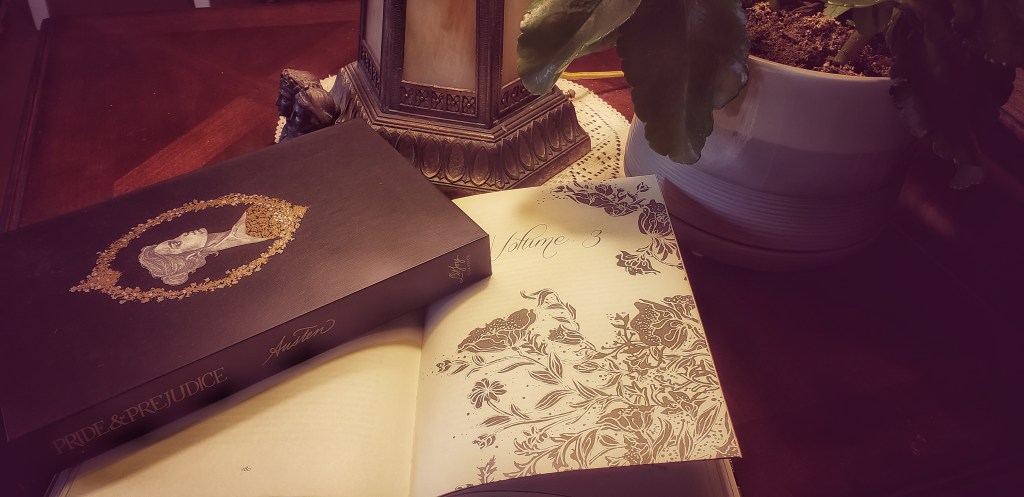
In returning to Jane Austen’s seminal work Pride & Prejudice, I knew I wouldn’t come out of it writing a review typical to what I’ve done for every other book I’ve finished. Such an endeavor would be at best unnecessary and at worst an arrogant waste of time. No one who has even a passing knowledge of literature in the English language hasn’t heard of Pride & Prejudice. Even those who may not have a positive opinion of the book can’t deny the long-lasting impact it has had on fiction. To take a lesson from Austen’s characters, attempting to traditionally summarize and review the book would be an exercise in utmost pride. Instead, I’d like to just talk about the structure of the Bennet family and how they create my favorite scene.
Our protagonist, Elizabeth Bennet, is an ideal perspective character for Austen to use. She provides the reader with a third-party analysis of countless interpersonal relationships revolving around her, due primarily to the bevy of Bennets we come to know. Much of the story consists of keeping track of the chaotic series of events that each of the Bennets take turns instigating and Elizabeth does her best to keep the peace and patch up any issues that arise.
Jane, her one elder sister, is highlighted as the most eligible bachelorette among them; her budding friendship with and eventual affection for the wealthy Mr. Bingley takes up much of the ‘will they, won’t they’ of the first act. She is well-mannered, eternally cheerful, and known to be beautiful. Lydia is the most junior Bennet, and along with her immediate elder Kitty is shown to be largely vapid and superficial, purely intent on flirting with and impressing young men. Their main goal seems to be surpassing their elder sisters and achieving marriage first. Mary, the middle child, seems least preoccupied with marital affairs. She is described as the least attractive of the sisters, though in the same breath she is always reported to be the most accomplished at things like music and embroidery.
As the story of a group of young gentlewomen in the regency era of British history, a high level of importance is placed on the idea of marrying well. For much of the book, it’s stressed how little it matters whether there is genuine affection and care in a match; as long as both sides are pleasant and agreeable, a marriage should be pursued if it can be seen as advantageous to the families. This perspective is most clearly held by the temperamental and flighty Mrs. Bennet. The Bennet matriarch bemoans the entailment of their home at Longbourne, which necessitates a male heir, forever removing their fortune from the five daughters. At the same time, her favorite feature about Mr. Bingley is simply his having “$3,000 [pounds] a year”, or, in regards to Mr. Darcy, his legendary “$10,000 a year”. Her opinions of them and other men are based solely on their wealth and the level of interest they give her daughters, and as soon as she feels her family has been spurned she rails against them with colorful vindictiveness.
Set in foil to her is the ever-pleasant and sarcastic Mr. Bennet. My personal favorite character, he could not care less about the politicking of marriage. It’s revealed that, though he at first held affection for Mrs. Bennet, he has long since fallen into a state of convenient cohabitation with her as he realized they couldn’t be further apart in temperament. He is soft-spoken in his wish for his daughters to live happily, not merely richly.
On to talking about my favorite scene. Mr. Bennet’s apparent apathy for marital jousting is revealed in the denouement. He despises the business of it all and holds the progressive (for the time) view that his daughters should marry for love. In his pivotal discussion with Lizzy regarding her engagement to Mr. Darcy, he seems to almost be testing her. He wants to make sure she is not focusing on his immense wealth and instead truly loves the man she had previously spent months proclaiming the villainy of. He professes, “My child, let me not have the grief of seeing you unable to respect your partner in life.” Elizabeth convinces him that she does; Mr. Bennet exudes pure joy when she then proclaims her affection for the man. I could almost see Mr. Bennet’s happiness as he responds, “I could not have parted with you, my Lizzy, to any one less worthy.”
I haven’t read any of Austen’s other works, but I have to feel like Mr. Bennet is her self-insert, to an extent. He provides such a clear criticism of the culture at the time that I have to believe this is Austen’s own voice speaking through. Bennet’s sheer progressiveness is what I think modern readers can latch on to so well, making him a character truly for the ages.
After this scene, Elizabeth reveals her engagement to Mrs. Bennet. Lizzy’s mother had, until very recently, held Darcy in the lowest of regards, only just earlier in the same chapter calling him tiresome and a distraction for Mr. Bingley’s courting of Jane. The paradigm shift Elizabeth’s announcement caused in her mother seems to entirely overwhelm her and she freezes, unsure what to make of it. Ultimately, in keeping with Mrs. Bennet’s history of shifting whims, she suddenly effuses at length about the virtues of Mr. Darcy and, again, his wonderful, glorious “ten thousand a year.”
Mrs. Bennet is not meant, neither in this scene nor the book as a whole, to express the same complexity as her husband. Though she cares deeply for her daughters and their well-being, she never stops being concerned primarily with their economic fortunes. Even when Lydia is seemingly spirited away by the villainous Mr. Wickham, she can’t help but be afraid of what it means for the girl’s standing as a marital prospect. Additionally, her distaste of Mr. Darcy was rooted in her thinking that he believed himself too good for the comparatively poor Bennets.
Lizzy understands a bit of her mother’s viewpoint. This same prejudice is what caused Elizabeth to spend the second act of the book convinced of Darcy’s prideful nature. Through misinformation and conjecture brought about by ill-intentioned reports of his conduct, she thought him responsible for not only sabotaging Bingley’s courting of Jane but also for greatly wronging his adopted brother Mr. Wickham. This hearsay, coupled with Darcy’s standoffish discomfort in social settings, caused Elizabeth to form a negative prejudice about Darcy.
In the heat of her distaste for him, Elizabeth vehemently rejects Darcy’s marriage proposal halfway through the novel. He then gives her a letter that at length lays out the truth of the two matters of rumor and how her prejudice against him misconstrued the facts. Lizzy’s pride, now mortally wounded, leads her to avoid Darcy at all costs, out of sheer shame for her presumptions.
In the denouement, Lizzy’s interactions with her parents lays out the balance of pride and prejudice that she and Darcy need to attain to find happiness together. Mr. Bennet insists on Lizzy maintaining a level of pride in her own self-worth as she deserves not an advantageous marriage but a happy, loving one with an equal, regardless of their wealth. Mrs. Bennet expresses, through dramatic comedy, the pains that excessive prejudice can cause in a person’s opportunities in life by learning to judge a person not based on rumor but on their actions. Mrs Bennet is herself not an adherent to this lesson; Lizzy simply learns to not follow her mother’s example here. Lizzy’s greatest character development, I think, is learning that rather than stewing on her own suppositions on a matter, she should confront it head on to find out the truth. Her mortification before Darcy enabled her to reevaluate not only him but herself and discover that she truly does love him.

