-
Pride & Prejudice’s Characters Evolve into a Perfect Denouement
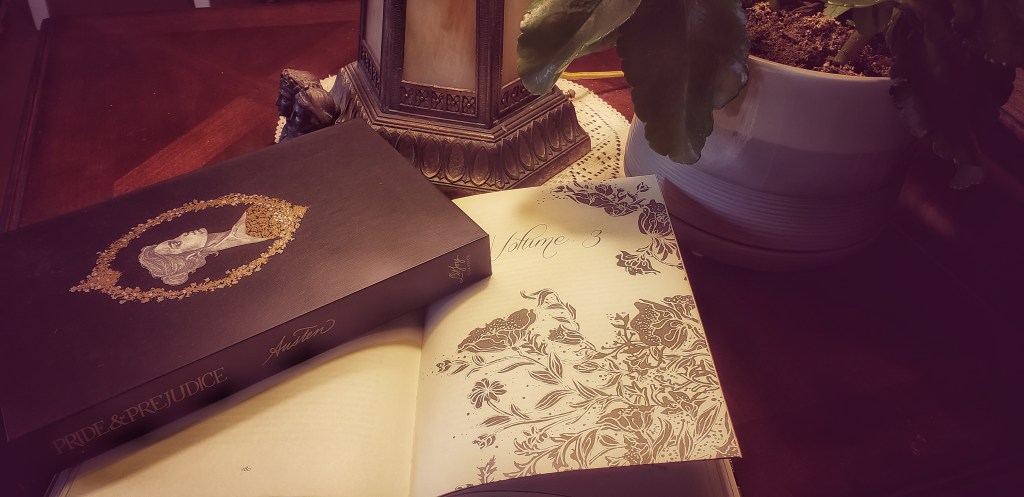
In returning to Jane Austen’s seminal work Pride & Prejudice, I knew I wouldn’t come out of it writing a review typical to what I’ve done for every other book I’ve finished. Such an endeavor would be at best unnecessary and at worst an arrogant waste of time. No one who has even a passing knowledge of literature in the English language hasn’t heard of Pride & Prejudice. Even those who may not have a positive opinion of the book can’t deny the long-lasting impact it has had on fiction. To take a lesson from Austen’s characters, attempting to traditionally summarize and review the book would be an exercise in utmost pride. Instead, I’d like to just talk about the structure of the Bennet family and how they create my favorite scene.
Our protagonist, Elizabeth Bennet, is an ideal perspective character for Austen to use. She provides the reader with a third-party analysis of countless interpersonal relationships revolving around her, due primarily to the bevy of Bennets we come to know. Much of the story consists of keeping track of the chaotic series of events that each of the Bennets take turns instigating and Elizabeth does her best to keep the peace and patch up any issues that arise.
Jane, her one elder sister, is highlighted as the most eligible bachelorette among them; her budding friendship with and eventual affection for the wealthy Mr. Bingley takes up much of the ‘will they, won’t they’ of the first act. She is well-mannered, eternally cheerful, and known to be beautiful. Lydia is the most junior Bennet, and along with her immediate elder Kitty is shown to be largely vapid and superficial, purely intent on flirting with and impressing young men. Their main goal seems to be surpassing their elder sisters and achieving marriage first. Mary, the middle child, seems least preoccupied with marital affairs. She is described as the least attractive of the sisters, though in the same breath she is always reported to be the most accomplished at things like music and embroidery.
As the story of a group of young gentlewomen in the regency era of British history, a high level of importance is placed on the idea of marrying well. For much of the book, it’s stressed how little it matters whether there is genuine affection and care in a match; as long as both sides are pleasant and agreeable, a marriage should be pursued if it can be seen as advantageous to the families. This perspective is most clearly held by the temperamental and flighty Mrs. Bennet. The Bennet matriarch bemoans the entailment of their home at Longbourne, which necessitates a male heir, forever removing their fortune from the five daughters. At the same time, her favorite feature about Mr. Bingley is simply his having “$3,000 [pounds] a year”, or, in regards to Mr. Darcy, his legendary “$10,000 a year”. Her opinions of them and other men are based solely on their wealth and the level of interest they give her daughters, and as soon as she feels her family has been spurned she rails against them with colorful vindictiveness.
Set in foil to her is the ever-pleasant and sarcastic Mr. Bennet. My personal favorite character, he could not care less about the politicking of marriage. It’s revealed that, though he at first held affection for Mrs. Bennet, he has long since fallen into a state of convenient cohabitation with her as he realized they couldn’t be further apart in temperament. He is soft-spoken in his wish for his daughters to live happily, not merely richly.
On to talking about my favorite scene. Mr. Bennet’s apparent apathy for marital jousting is revealed in the denouement. He despises the business of it all and holds the progressive (for the time) view that his daughters should marry for love. In his pivotal discussion with Lizzy regarding her engagement to Mr. Darcy, he seems to almost be testing her. He wants to make sure she is not focusing on his immense wealth and instead truly loves the man she had previously spent months proclaiming the villainy of. He professes, “My child, let me not have the grief of seeing you unable to respect your partner in life.” Elizabeth convinces him that she does; Mr. Bennet exudes pure joy when she then proclaims her affection for the man. I could almost see Mr. Bennet’s happiness as he responds, “I could not have parted with you, my Lizzy, to any one less worthy.”
I haven’t read any of Austen’s other works, but I have to feel like Mr. Bennet is her self-insert, to an extent. He provides such a clear criticism of the culture at the time that I have to believe this is Austen’s own voice speaking through. Bennet’s sheer progressiveness is what I think modern readers can latch on to so well, making him a character truly for the ages.
After this scene, Elizabeth reveals her engagement to Mrs. Bennet. Lizzy’s mother had, until very recently, held Darcy in the lowest of regards, only just earlier in the same chapter calling him tiresome and a distraction for Mr. Bingley’s courting of Jane. The paradigm shift Elizabeth’s announcement caused in her mother seems to entirely overwhelm her and she freezes, unsure what to make of it. Ultimately, in keeping with Mrs. Bennet’s history of shifting whims, she suddenly effuses at length about the virtues of Mr. Darcy and, again, his wonderful, glorious “ten thousand a year.”
Mrs. Bennet is not meant, neither in this scene nor the book as a whole, to express the same complexity as her husband. Though she cares deeply for her daughters and their well-being, she never stops being concerned primarily with their economic fortunes. Even when Lydia is seemingly spirited away by the villainous Mr. Wickham, she can’t help but be afraid of what it means for the girl’s standing as a marital prospect. Additionally, her distaste of Mr. Darcy was rooted in her thinking that he believed himself too good for the comparatively poor Bennets.
Lizzy understands a bit of her mother’s viewpoint. This same prejudice is what caused Elizabeth to spend the second act of the book convinced of Darcy’s prideful nature. Through misinformation and conjecture brought about by ill-intentioned reports of his conduct, she thought him responsible for not only sabotaging Bingley’s courting of Jane but also for greatly wronging his adopted brother Mr. Wickham. This hearsay, coupled with Darcy’s standoffish discomfort in social settings, caused Elizabeth to form a negative prejudice about Darcy.
In the heat of her distaste for him, Elizabeth vehemently rejects Darcy’s marriage proposal halfway through the novel. He then gives her a letter that at length lays out the truth of the two matters of rumor and how her prejudice against him misconstrued the facts. Lizzy’s pride, now mortally wounded, leads her to avoid Darcy at all costs, out of sheer shame for her presumptions.
In the denouement, Lizzy’s interactions with her parents lays out the balance of pride and prejudice that she and Darcy need to attain to find happiness together. Mr. Bennet insists on Lizzy maintaining a level of pride in her own self-worth as she deserves not an advantageous marriage but a happy, loving one with an equal, regardless of their wealth. Mrs. Bennet expresses, through dramatic comedy, the pains that excessive prejudice can cause in a person’s opportunities in life by learning to judge a person not based on rumor but on their actions. Mrs Bennet is herself not an adherent to this lesson; Lizzy simply learns to not follow her mother’s example here. Lizzy’s greatest character development, I think, is learning that rather than stewing on her own suppositions on a matter, she should confront it head on to find out the truth. Her mortification before Darcy enabled her to reevaluate not only him but herself and discover that she truly does love him.
-
Babel: An Arcane History – a Period-Piece Tackling Colonialism that Struggles at the Finish Line

Babel, Or the Necessity of Violence: An Arcane History of the Oxford Translators’ Revolution by R.F. Kuang is a 2022 historical fiction standalone novel. It tells the story of a fictional college in Oxford, Royal Institute of Translation, also known as Babel, which teaches its students the intricacies of translation. Its students are trained toward a few careers, including traditional diplomatic translators, researchers, and legal experts. The flashiest and narratively most important track is in silver-working.
In this world, etymological translation has a very real power that, when inscribed upon bars of silver, can cause tangible effects in the world by fusing the difference in definitions. These fictional qualities of silver turns this story that almost reaches the level of fantasy, though it never quite crosses the threshold. It takes the approach of showing highly advanced science as indivisible from magic, a trope that I am no small fan of. Silver-work is a complicated process, but I’ll do my best to explain it:
Because it’s reliant on translation, the process starts with a word whose meaning changes through its transformation across cultures. Arcane, from the book’s full title, is perhaps a good example. Imagine you have a book full of information that you want to keep secret and inaccessible. Arcane is used in modern English to describe something that is “understood by few; mysterious or secret.” If taken back to its Latin roots, arcere means “to shut up” and arca means “chest”. So, a silver-worker in Babel could inscribe arca/arcere, and arcane on a bar of silver, place it in the spine of a book, and the pages will be locked tight, unable to be opened and risk revealing the secret information within. There are more rules and limitations, but that’s the basic theory.
Side note: Arcane also has a modern connotation relating to magic, creating a double entendre in the title that makes the reader question whether the science at work is magic or not.
It’s honestly a fascinating idea for a magic system. It utilizes the traditional concept of magic spell words in a fresh manner that, if you pay attention to the definitions at work, makes a satisfying amount of sense to the reader. Plus, as a habitual etymology-Googler, I was naturally inclined to follow the research of the characters.
Kuang uses this technology as a basis to discuss the effects of British colonialism in the Empire in the 1830s.
When the book takes place the Empire has spent decades expanding its influence in an effort to do two things: mine silver from its colonies and extract skilled linguists from their homelands. That’s where our main character comes in. He was born in Canton (now Guangzhou) amid the Asiatic Cholera Epidemic. His family was decimated and he only survived due to his adoption by a wealthy Babel professor. He receives his English name, Robin Swift; we never learn his Chinese name for the duration of the novel, thus serving a greater theme of anglicization.
As the book progresses, Robin discovers firsthand the effects of British colonialism on his homeland and the homes of his Oxford classmates. Everything culminates in an eventual return to Canton, wherein Robin plays an important role on behalf of the British in attempting to strongarm the Chinese into opening trade to British opium. He witnesses firsthand the racism, oppression, and dehumanization exhibited toward his people and concludes that he himself will never be seen truly as one of the British. This results in the revolution mentioned in the book’s title.
There is a unique quirk of Babel’s silver-working that supports the themes of anti-colonialism. The silver bars will only work if the translated languages used are actively extant and practiced in the world. Accordingly, Babel’s researchers show this tug and pull as they try to balance their need for specific translations with the homogenization their own colonizing causes. The more the Empire spreads, the more languages die, and the more linguists they remove from their homes, the fewer translation options are available for the silver. This creates a tension that feels like a typical energy crisis felt by a nation.
Babel shines in its meticulous recreation of 1830s England. I certainly don’t intimately know the cultural history of Oxford, but it comes across clearly that Kuang does. The research she has put into depicting the world of Babel conveys the confidence of the author’s writing so vividly I know I can trust it as accurate. On occasion I did look up certain terms and locations to get more of a background; I was thrilled to find the exact location where Robin lived in Oxford in online images and even today it resembled the writing exactly.
Robin meets up with his cohort at Oxford early in the story. The four of them, all told, make up a diverse group with only one of them hailing from England. Two of the cohort are women, and the two men and one of the women are visibly foreign to Oxford. Kuang goes to great lengths to show the prejudice felt by the characters in terms of race and gender. They slowly start to realize that no matter how much they prove themselves in academia they will always be seen as ‘other’.
The main star of Babel is Oxford itself, its many colleges and libraries, and the lives of its researchers.
This focus on school life is truly welcome. All too often, it seems like the actual ‘school’ part of academic settings is glossed over and the professors’ lectures are hardly ever featured. In this case, a significant portion of the book is devoted to long, drawn out lectures and academic dialogues that made me feel like I was sitting in the room myself listening to the instruction.
While Oxford was fascinating to explore, the worldbuilding in the greater Empire was puzzling. When I first picked it up, I expected to read an account of a world history that was massively altered by this translation technology that had been developed. It’s made clear that the entire infrastructure of the Empire would fail should the silver bars be removed. However, Kuang could effectively be telling a story of the actual history of colonialism because nothing is really different.
Babel occupies this strange space between historical fiction and historical fantasy. It’s not quite an alternate history, but neither is it fully in the realm of the real.
Curiously, it doesn’t seem like any significant technologies were replaced or massively enhanced by the silver. There were whole sections where I forgot that the silver bars existed and was surprised when suddenly some borderline-magical effect was produced. Because of the sheer power of silver, I expected 1830s Britain to exhibit the technological prowess of a world decades in the future, at a minimum. That wasn’t the case. Instead, it became clear that it was just the historical British Empire with silver-working present but ultimately inconsequential to the plot until the climax. There was certainly a dichotomy to be felt between Oxford and Canton, but it was not dissimilar from what could be expected for the time in our own reality.
Where I feel the book falls flat is, unfortunately, at the very end. Babel ends with the titular revolution, though it takes the form of a worker’s strike in the college’s tower. The climax is almost entirely just the main characters watching the fallout of their strike unfold. Their weapon in this conflict is the restriction of resources that when withheld causes infrastructure to fall apart in the Empire. There is no antagonist beyond, I suppose, ‘the elite’ of Oxford and greater Britain. Robin himself makes some questionable choices and honestly goes through some inexplicable character development that sees him becoming a bit of a villain. He gives in to the simmering rage he has felt at the Empire and seems willing to bury every Englishman in misery to prove a point.
This climax doesn’t work, though, because that means one hundred pages of what should be the most exciting part of the story is devoted to the main characters (and, by proxy, the reader) literally sitting in a tower and reading about or being told what’s actually happening outside the walls. As I got to the last forty pages or so, I realized I was reading a newspaper relaying the events of the day. Pages would go by where Robin and the others wouldn’t do anything. They would spend their time moralizing while Robin descended into philosophical villainy. I held on, not least because I was five hundred pages in, but also because I was anticipating Robin emerging from his pessimism and using the power of Babel to directly enact some sort of revolution to remove the systems of power the novel has been criticizing.
In the end, they didn’t. They simply withhold the power of silver from the Empire, causing worldwide catastrophe, deaths, and untold suffering of the citizenry. The characters know they aren’t causing irreparable harm to the Empire as it will eventually pull itself out of the ashes. I found myself agreeing with this viewpoint as, again, the setting hadn’t established why the British Empire couldn’t revert to non-silver infrastructure. Instead of the triumphant revolution I was expecting, it had more of a feel of the characters at their wits’ end screaming “I’m taking you down with me” as they ran out of options.
Invoking the ‘Tower of Babel’ conjures the message of the British Empire reaching too high in its hubris to culturally dominate the world only to ultimately, spectacularly, fail. Robin fulfilled the biblical allusion by destroying the tower and perpetuating the suffering that the strike was causing. I was left disappointed and disillusioned by Robin’s moral failing. Further, I did not sympathize with the tragic plight of the strike our protagonists led. The British Empire would churn onwards, in spite of the pain of its citizens.
Additionally, because it’s impossible to read this book without thinking of the biblical Babel, I felt like the final climax, the destruction of the tower, was unearned. To me, this comes off as heavy-handed due to its predictability. If you know anything at all about the mythological origins of the word ‘Babel’, you could’ve guessed what would happen to the very literal tower on the cover of the novel from the first time you picked it up.
From the beginning I felt like I was looking at the completed image of a jigsaw on the box and connected all the puzzle pieces as I reached the final scenes.
Even considering my faults with the Babel, the novel remains a valuable read. The slow burn story develops into a crescendo at the end of the second act that fully engrossed me in the writing. The climax unfortunately ends up dragging on too long for its own good and leaves me unsympathetic to the protagonists.
Though I feel it fails to choose whether to be either a fantasy or fully-developed alternate history, Babel’s greatest success is as an engrossing and well-researched examination of early- to mid-nineteenth century Britain and the effects of its colonialism, both at home and abroad. It examines the mindset of those who are assimilated into Western culture and yet are still ostracized. Kuang uses her mastery of linguistics and classical writing to develop a rich world in Oxford. I may have been disappointed in the ending, there are lessons on colonialism and complacency that felt eerily relevant to today’s conflicts.
-
The Rings of Power is the Right Direction for Tolkien’s Work

Note: I apologize in advance for wading into an already crowded discourse on the internet. However, as long as the pattern of criticism continues, it deserves calling out.
I have the blessing – and curse – of calling myself a fan of some of the biggest intellectual properties out there. Star Wars, The Lord of the Rings, and Marvel rank among my favorites. Each of these come from decades of narrative and worldbuilding baggage that the fanstm require more casual watchers to be caught up on at all times (see: Glup Shitto). Personally, I love it. I can spend hours on Wookieepedia or Tolkien Gateway reading about all the interconnecting narratives. When Nick Fury said “Mr. Stark, you’ve become part of a bigger universe,” in 2008’s Iron Man, he was talking to every pop culture title in existence.
Since then, everyone else seems to be trying to initiate their own ‘cinematic universe’. To put it briefly, a cinematic universe is a connected story over many films and other media. This was a natural development for movies from Marvel and later DC as this philosophy is how their physical comics have endured for decades. Star Wars Legends (the pre-Disney buyout canon) was a massive literary undertaking, with countless books, comics, and video games that told a largely cohesive story about the galaxy beyond the movies, many details of which are now bleeding into the Disney canon. Modern takes on the cinematic universe range from the more successful LEGO cinematic universe and Monsterverse to Transformers and the laughably ill-fated Dark Universe.
Forgive me if the syllable ‘verse’ has been overused already in this piece. Granted, it’s exhausting keeping up with all the universes as a fan anyway.
As soon as Amazon announced their now-released Lord of the Rings project, I was in equal measures ecstatic and apprehensive. They made it clear that The Rings of Power was to be incorporated into a cinematic universe. It was to include the original six Peter Jackson movies and this new Amazon show, with an implication of more to come.
This announcement was of course met with all sorts of opposition, making my apprehension well-founded. The more genuine criticism concerned a perceived watering-down of Tolkien’s messages that had started with the Jackson films. A New York Times Opinion by Michael Drout avoids the emotionally charged rhetoric that colors the bowels of the Twitterverse so it proved a worthwhile read. His argument relies upon his fear that Amazon executives would misinterpret or abandon the “moral heart of his story” and become something akin to the long, drawn-out Hobbit trilogy. He ends by saying that if The Rings of Power fails, it “will be because the new adaptation lacks the literary and moral depth that make Middle-earth not just another cinematic universe but a world worth saving”.
Regarding The Hobbit: I agree that Jackson’s movies lost their way somewhere in the production of the trilogy. I’m a fierce defender of the relevance of much of the content and plot of those movies, as they all have some basis in Tolkien’s writing. At the same time, though, I agree that the added storylines took away from the central focus that should have been on Bilbo Baggins and his journey with Thorin’s company of dwarves. I think Jackson wanted to deliver in The Hobbit trilogy a similar bombastic epic tale told to The Lord of the Rings, ultimately resulting in the mess that was The Battle of the Five Armies. The better move would have been to keep the focus on Bilbo and develop the dwarves more completely; as it stands more than half of them are pure caricatures with no identifying characteristics beyond the surface level. The much maligned elf-elf-dwarf love triangle was really the only character development addition made by Jackson.
However, I staunchly believe The Hobbit trilogy shines brightest in its quieter moments. Lee Pace is an imposing and austere Thranduil and I’ve always appreciated Ken Stott’s thoughtful and reflective Balin. Bilbo himself steals all of his scenes; his fateful encounter with Smaug and the screen adaptation of “Riddles in the Dark” are still moments I go back to watch regularly, thanks in large part to the performances of Andy Serkis, Benedict Cumberbatch, and Martin Freeman. Freeman in particular so purely represents what it means to be a hobbit in Tolkien’s world; fiercely loyal, exceedingly curious, and risk-averse to a fault. His interpretation of Bilbo Baggins makes the entire series a valuable watch.
Regardless of the extravagances of the series, The Hobbit still contained that spark of Tolkien. Tolkien’s books focus on the joy of camaraderie and discovery, of being a fierce defender of the natural world. Hobbits as a whole are an encapsulation of Tolkien’s themes; embracing the fear of the unknown but overcoming it nonetheless.
The Hobbit films continued Jackson’s innate understanding of what it means to be a hobbit by making Bilbo’s courage shine in opposition to his natural timidity.
We arrive now at The Rings of Power, the first cinematic undertaking in Tolkien’s world for nearly a decade. The story being adapted reached further back into the legendarium than before, telling an origin story for the titular rings of power and taking place millennia prior to The Lord of the Rings.
Tolkien fans hold his works to be paragons of literature, insofar as there being a proto-academic field of study populated by ‘Tolkien Scholars’. This study is held almost to the point of biblical reverence. Tolkien’s writing is often seen as infallible, perfect in its portrayal of its fictional retelling of Western European history, yet at the same time immune to analyses modernizing it to the world of today or worse, abridging Tolkien’s own stories to be more inclusive. Any criticism of Tolkien’s writing should accordingly be isolated as a result of the times that he was writing in; any adaptations of his work should be done sparingly if at all and not reflect these criticisms, no matter how valid.
The immediate backlash to the earliest images of Amazon’s The Rings of Power was as vitriolic as it was sadly predictable. It was clear that the showrunners were altering the narrative to some extent by focusing on characters original to the show and having the audacity to put Galadriel into a suit of armor. The loudest, most abrasive criticisms were to the characters of the Dwarven Disa and Elvish Arondir. Both of these characters were original to the show, though Disa existed at least in implication as the wife of Durin IV.
The fact is both characters and their actors are non-white. If you’re not familiar with the discourse of Tolkien, understand that there is a long history of racialization in his writing. In Middle-Earth, and Arda at large, races are homogenized; Men of the West, Elves, and Dwarves are never described as anything other than white. Accordingly, objections to these characters are often laid beneath a veneer of scholarship as they rely on evidence from Tolkien’s writing that this sort of racial diversity shouldn’t exist in Middle-Earth.
Sociologically speaking, racialization is ascribing to groups certain inherent, immutable qualities that don’t reflect reality and that the groups did not choose for itself. Dwarves are a race of mountain- and cave-dwelling miners that covet gems and gold. Men (the term is herein an analogue for ‘human’, yet is always gendered unnecessarily) are ambitious and short lived, susceptible to acts of greatness and darkness. Elves, the most civilized and powerful of races, are uniformly fair-skinned and haired. Meanwhile, Orcs are a race of dark, twisted creatures who speak the “Black Speech”.
Further, the only members of the race of Men in Tolkien’s legendarium that appear to be non-white are the Men of Harad. The desert-dwelling Haradrim run the gamut of descriptions in Tolkien’s writing. At times they are “fierce dark men of the South”. Other times, they are described as “black men like half-trolls with white eyes and red tongues” and “troll-men”. In The Two Towers, they are described as having “brown skin”, with black plaits of hair braided with gold. With their massive war elephants and curved scimitar blades, they are clearly coded after all sorts of stereotypical and historical examples of Middle-Easterners and Africans. Most importantly, they are all depicted as being servants of evil.
The Haradrim and other denizens of eastern lands in Middle-Earth are separated from the heavily European-coded “Men of the West” where all of our heroes of Men come from. This separation damns the Men not from the western lands; they are servants of Sauron and therefore evil. It is key to note that this treatment depicts them essentially as perpetually in error and separated from their brethren.
It’s well known that Tolkien may very well be the most influential writer of fantasy. Accordingly, his use of racialization has had a profound impact in the genre. The modern high fantasy concept of what constitutes an ‘elf’ and a ‘dwarf’ comes from Tolkien and has been adapted in countless settings since. We are still reckoning with this today. Recently, the Dungeons & Dragons sourcebooks have begun removing racialized language that essentially mirrored Tolkien’s approach to ‘evil races.’ Before now, D&D has had all sorts of monstrous and evil races that have been natural fodder for the ‘good guys’. In the source material, most D&D elves are separated from their siblings the Drow, or dark elves. Yes, their skin is literally black and they are naturally evil. Ouch. More recently, the evil races have been granted leniency in their writing, leaving it ultimately up to the players to decide who the characters are.
The most prevalent defense of Tolkien’s depiction of race in Arda generally relies on an argument that it is modeled after medieval Europe. As if Europe in 900 A.D. was perfectly racially homogenous, populated purely by white people. Of course, Tolkien could very well have been writing his world based on his understanding of systems of power in the Middle Ages which, admittedly, was heavily white-favored.
That doesn’t mean we can’t call out his writing as
incorrect and make changes to it.In fact, historians alive in the 11th century made note of the diversity of the largest cities in England. The Medieval writer Richard Devizes describes London as being “populated by ‘Garamantes’ (Moorish Africans), and ‘men from all nations’ that ‘fill all the houses.’” Devizes goes on to describe the various terms used to refer to these people, including “‘Black’, ‘Ethiopian’ (a word used at the time to describe all Africans), ‘Moor,’ and ‘Blackamoore.’” Englishmen of African descent continued to populate England spreading to smaller and more rural towns into the Tudor era. Further, if we are going to rely on the Medieval allegory, then the conflict between Men of the West and their ‘evil’ eastern and southern brethren necessarily brings to mind the long and bloody conflicts of the Crusades.
When The Rings of Power ultimately released and these criticisms resumed, I said to myself, “not again”. Just months had passed since the debacle of Reva in Kenobi, another “written-in” black character who was deemed illegitimate for all sorts of cursory reasons. Suddenly thousands of Twitter users decided they were formally trained screenwriters and could judge Reva’s story as complete trash, even after just the first two episodes. Yet, even as her story and motivations continued to unfold (and honestly told a compelling and well acted narrative), the same accusations continued. The internet exploded for a few weeks, with official Disney and Star Wars channels branding all critics of Reva as racists, something that only inflamed the discourse.
Both Star Wars and The Lord of the Rings are hallmarks of 20th Century (science) fantasy. Both were originally conceived and portrayed with limited or no racial diversity. The original Star Wars trilogy fared better than Tolkien on this front, showing some improvement in the four decades separating their debuts, but it still included very few non-white or non-male prominent characters. To its credit, Star Wars has continued to promote diversity. Now, we’re at the point where the franchise’s most popular character, Ahsoka Tano, is played in live action by a black actress.
Why should Tolkein’s writing and its modern adaptations be immune to these sorts of improvements to tell a more inclusive and frankly more realistic story? It hurts no one to include an Afro-Latino elf, an Afro-Iranian dwarf, or a Jamaican-British hobbit.
Insisting that Tolkien’s adaptations remain white is racist. Plain and simple. There is no argument to be made about maintaining the spirit of the text. Tolkien’s books can be both masterful experiments in fantasy and racially exclusionary at the same time. Was Tolkien racist? No, I don’t think so. He, like many others of his contemporaries, just lived in a world where educated white men controlled everything. We know that this view is wrong and we don’t have to maintain it in some twisted example of historical accuracy.
The vocal minority in the Marvel, Star Wars, and The Lord of the Rings fanbases are very loud lately. All three of their most recently completed shows, She-Hulk, Kenobi, and The Rings of Power, have faced criticisms of their characters based on gender or race, or both. I haven’t watched it, but House of the Dragon seemed to also encounter the same headwinds as a result of casting black actors. It’s tiring having to wade through this discourse on Twitter and elsewhere, to the point where I’ve now written off content creators based on their suddenly anti-diversity views.
Before I sign off I just want to take this opportunity to say that Sophia Nomvete’s Disa and Ismael Cruz Córdova’s Arondir have immediately become two of my favorite characters in this new Lord of the Rings-verse.
Nomvete particularly gave a stirring performance as the Dwarven princess, providing a level of sympathy and humor to Khazad-dûm’s drafty halls that played well off of her emotionally closed-off husband Durin and her attempts to provide hospitality for Elrond. Disa encapsulated a first season of The Rings of Power that focused on the message of crossing ingrained cultural boundaries and finding common ground. Personally, I’d say paragons of character like Disa would be perfect for Middle-Earth’s continued development in the 21st Century.
I think I’ve rambled enough at this point. Racialization in fiction casts a long shadow from the founding works of modern fantasy that we clearly still have to deal with. I hope to continue to see showrunners push the envelope and try new ideas.
-
Harrow the Ninth – Delighting in Misdirection

Harrow the Ninth is a 2020 science fantasy novel by Tamsyn Muir. It’s the sequel to the series’ debut, Gideon the Ninth and overall the second entry in The Locked Tomb series. As the title implies, the reticent and dour Harrowhark Nonagesimus becomes the main character in this book as she wades through the consequences of Gideon Nav’s self-sacrifice at the end of the first installment. The primary conceit of the novel, however, is that not all is as it seems in Harrow’s telling of the first year of her Lyctorhood.
What struck me immediately as I began reading was the variety of perspectives given by the narrator(s). First off, Harrow’s continuing story from the end of Gideon the Ninth is told in a second person perspective. Rare enough on its own, the use of this perspective is compounded by the fact that the narrator is unidentified. The text reads as if someone is writing a letter to Harrow with many uses of the word ‘you’ to refer to harrow. My initial thought as I was reading was that the narrator itself was Harrow recounting the story from a later time. It’s clear that the narrator has intimate knowledge of Harrow’s thoughts and feelings through the story, so that was my natural conclusion.
Of course, this is only half the story; there’s a second narrator, this time in traditional first person from Harrow’s perspective. The chapters trade off between two narratives, one the natural continuation of Gideon’s story while the second, first-person one is a twisted and remade version of the events of Gideon.
This retelling has characters mixed around or entirely missing. Perplexingly, characters who perished at certain points in Gideon instead survive longer than they should have, making me question my own recollection of events. There’s no in-text explanation for this for much of the runtime of Harrow. It instead occupies this strange, dreamlike quality because it assumes that the reader would intimately know how wrong this retelling is.
What results is an infuriatingly puzzling yet fascinating example of an unreliable narrator diegetically incorporated into the writing itself. Between every chapter I found myself taking stock of what I’d read and trying to square it with what I thought was going on on a macro-scale. I revised my theories multiple times as I read, making me feel at times like a detective uncovering the truth of the events. I had the feeling that Muir had managed to write a 500-page riddle that took the near entirety of those pages to piece together.
Muir’s unique writing style extends to the dialogue of the characters as well. Since Gideon, I’d been impressed by the sheer vocabulary on display. I found myself thinking that it felt like an anatomy textbook had vomited itself into the manuscript for Harrow, but it’s appropriate for the narrative. The necromancers that make up the main cast are experts in corporal magic. They naturally use all sorts of medical and anatomical terms in their speech that make perfect sense in context, even if my limited knowledge can’t exactly parse their meaning. All too often I was finding myself looking up the words, or even asking my medically-trained family for context, and as soon as I read the details of what strange bodily part was being discussed I would laugh at the perfect strangeness of the term.
Harrow, herself an expert in bone manipulation, could mentally identify the exact locations where she becomes injured. On other occasions, she’s able to channel her magic, here called thanergy, to precisely manipulate specific bones, conveying a sense of the strategy involved in the book’s magic system.
Regardless of what I loved in Harrow, I’d be remiss to gloss over what I consider a bit of a slow start. Something I noticed in Gideon as well is the writing’s almost aggressive lack of exposition. I do appreciate Muir letting the reader figure out things as they go along; that said, both books in the series so far do suffer from very difficult beginnings, just because there is so little actual explanation of the setting and the admittedly complex magic system. Most if not all questions do get answered by the end. In spite of this, I did struggle through the beginning as a result of not exactly understanding what was going on (which was compounded by the confusing retelling of Gideon’s events). This method of writing does help to draw the reader into the world, once they’re acclimatized, but I can see it causing a lot of people pause; I almost put down Gideon before I was able to really get into it.
I left Harrow the Ninth feeling like I’d just unwound a most fascinating puzzle box. When the final reveal actually unfolds, I felt like I had triumphed in successfully solving the conundrum of the story. Nothing is obvious prima facie to the reader; Harrow is the sort of book that you have to trust the author to hold the curtain closed and confirm the details about later on.
When I reached the finale, and with the answer before me, I was able to look back at all the events of the novel and make sense of what I’d read. In an exciting twist, the true identity of the second-person narrator is revealed and actually becomes first-person in a lexical turnabout that truly astounded me as I was reading.
It’s not all just wordplay and mindbenders; Muir was able to convey a message of learning to rely on the people who want to support you. I would normally say that it’s a somewhat basic and uninspired theme, but I’m leaning towards it working well for Harrowhark as it encapsulates the journey it was obvious she needed to take. Harrow was a supporting character in Gideon, and we were able to feel Gideon’s frustration at the rugged and infuriating individualism Harrow embraced, much to the detriment of her own health.
In Harrow, with the identity of the narrator and the meaning of the twisted flashbacks revealed, it makes sense to embrace this theme. Harrow is a career climber, willing to step on others to ascend the ladder. She refuses to properly process the sacrifice that Gideon made in the first installment in laying down her life for her, to the point where it feels like Harrow tried to carve any memories of her out of her mind. In the climax, Harrow is forced to rely on the necromancers and cavaliers primary from Gideon the Ninth in the face of her own helplessness and it truly feels like Harrowhark ends the story as a more developed person. This lets a rather simple theme form a level of nuance that truly works in Harrow the Ninth.
-
Polytheism in Fiction – Lyons’ Eight Immortals
When we talk about worldbuilding, there are umbrella concepts that automatically come to mind. Every setting needs to have a few basic elements to ground it: cultures, landmasses, relevant history, languages, that sort of thing. Tied in with that is a world’s religion; in particular, the gods that inhabit a world and its faiths. This makes sense, from our viewpoint.
Whether you’re religious or not, you can’t deny that the presence of religion on Earth has played a major factor in its history and in the development of our various cultures. Accordingly, if the world you’re writing resembles our own, the design of its religion(s) plays a large role in coloring the setting properly.
Polytheism and its Role in Fiction
For my part, I’ve always been fascinated by polytheistic traditions. It feels to me like it has a high prevalence in modern fantasy. To be fair, the sample of books I’ve read is fairly selective for, among other things, the way they incorporate gods.
I’ve been a fan of these sorts of traditions since I was seven or eight and my mother bought me my first book of Greek myths. I read it cover to cover countless times, each occasion as special as the last thanks to the liberal amount of illustrations and its child-friendly adaptations of the classic stories. When I began seeing these myths reflected in the movies I watched or in other books I read, I began to feel the value of learning about these ancient faiths.
Though it fails to accurately reflect The Iliad, the movie Troy absolutely blew young me away in its larger-than-life representation of the stories I’d read.
Since then, I’ve dove into various other traditions. The Norse gods came easy to me because of my father’s own collection of The Mighty Thor comics. Though very few of the gods represented their Marvel counterparts, that was at least a jumping off point. An elementary school brush with Okami primed me for learning about the Shinto tradition, something that has since been contextualized by the spiritual messages of Miyazaki-san’s Princess Mononoke, another formative part of my childhood. I’ve spent a lot of time lately getting to know the myths and legends of the Tuatha Dé Danann of Celtic tradition. I’ve dabbled in Egyptian, Hindu, and Persian traditions more recently (even taking some inspiration from the latter for my current project).
My early exposure to Thor I think helped color my view of polytheism generally and how I always view the traditions through a sort of fantasy adventure lens. While they served all sorts of purposes, including story telling, organization, and metaphysical foundations, many of them always just seemed so heroic and exciting. The Epic of Gilgamesh, perhaps human history’s first written tale, was foundational not only in its being the earliest example of literature, but in that it showed gods in a fantastical setting full of momentous and calamitous deeds.
Gods have always been important to storytelling, going back to literally the first story.
Back to worldbuilding: a believable fantasy world should have some tenets of faith represented. In the most abstract sense, they can just dictate the rituals and traditions that your main characters adhere to. Let your characters’ ideals and virtues say something about the gods, and vice-versa. You can have perfectly virtuous and heroic characters following a god of death that requires ritual sacrifice.
For example take the death priestess Pyrre in The Unhewn Throne. She plays the assassin archetype, someone who makes a holy living through death and is, on the surface, amoral in her devotion to a god of death. She easily could have been portrayed as a one-dimensional villain, but author Brian Stavely turned her into a fairly integral protagonist. Her role is naturally bloody and violent, but Pyrre sees the death she causes as a holy sacrament and a necessary part of life. Her initial moral conflict with the other characters, many of whom were disgusted by her blunt approach to murder, can similarly provide a complex background to your characters.
I think it says something that Stavely created a prequel series entirely about Pyrre; haven’t gotten to it yet, though.
But sometimes I like to see gods who get out there and do the dirty work themselves (thanks Thor). Gods are never required to be separate, just above the rank and file. They are forces of nature personified, housing unimaginable magical power bent to the whims of all-too-often very human personalities. There’s no greater tale of heroic deeds than a person rising up against a god and emerging victorious.
Jenn Lyons’ Approach to Anthropomorphic Polytheism
What is anthropomorphic polytheism? I found this term defined on Britannica, so let’s start there. It refers to gods that “appear in human form but have superhuman powers”. This could, of course, be immediately seen in all sorts of polytheistic traditions, including the ones I’ve referred to already. Greek and Norse myths are full of this, with gods descending from Olympus or to Midgard and waging war, performing great works, and the like.
This concept is ripe for exploration in fantasy fiction. Investigating the relationships between humans and gods is not only pure fantasy, but pure storytelling as well. Conflict between humans and the supernatural (i.e. gods) is one of the classic plot frameworks. Anthropomorphization challenges this structure by compounding the conflict in your story.
A humanized polytheism allows for man vs. supernatural and man vs. man conflict to develop concurrently, ultimately enriching the setting as a whole.
The banner example of a humanized polytheism in fantasy is the one set up by Jenn Lyons in A Chorus of Dragons. She unifies conflicts versus man and the supernatural in a way that can only be accomplished in high fantasy. I hope to show below how Lyons’ worldbuilding and use of polytheism advances the thematic background of the series, and I will conclude by putting forward what I think her story has to say about our own world.
Thesis out of the way, now for a little background info – the gods in this setting are referred to as the Eight Immortals. They are beings who represent eight distinct facets of their world: life, death, magic, luck, destruction, invention, stars and the sky, and the world. These are familiar concepts. Virtually every polytheistic tradition has at least one analogue that can be applied to each of them.
In The Ruin of Kings, the series’ opener, the reader gets to meet one of these Immortals very early on, and her identity is not kept a secret. In Ruin, the goddess Thaena plays a fairly significant role as a minor antagonist, imprisoning the hero on a remote island (though ultimately for his own good).
This arrangement sets the tone for the entire series. As it goes on, the Immortals tend to be treated just like any other character and they run the gamut from protagonist to antagonist and everything in between. This serves the larger themes of Chorus by establishing the relative helplessness that humans have against the workings of the very present gods. It is very clear who controls the world here; it is the ultimate goal of the series’ villain to find a way to throw off these shackles, though his self-preserving tendencies and lack of imagination would doom the rest of reality.
Lyons takes a very cavalier approach to incorporating the Immortals into the narrative and the world at large, making them hardly different from the more ‘normal’ humans that the reader identifies with.
Mid-series spoilers ahead.
The Immortals’ immediacy is bolstered by the eventual reveal of their true origin. They were transformed from normal humans by the villain, and then further used by him in a ritual to fight demons. Naturally, this went awry. In a fit of irony, this second ritual resulted in the god of the stars being transformed into a being that’s basically a human-shaped black hole. What followed was a slap-dash approach to seal the destructive god away, kicking the can down the road, fully knowing that the seal wasn’t permanent.
In the millennia since, the remaining Immortals have set themselves up as the gods of the world, with vast organizations of worship and even aristocratic frameworks popping up in their service.
The goddess of death, Thaena, is known throughout the world for her ability to ‘Return’ dead souls to their bodies. As a result, a practice reminiscent of Catholic indulgences has popped up where her priests are essentially bribed to beg her to Return a human, something we know she can accomplish on a whim. It’s corruption in its purest form, and Lyons’ writing delights in it to the fullest.
It is a reveal full of existential dread when the protagonists learn of the falsehoods their worship is built on, ultimately culminating in finding out that the Immortals had been using the lives of humans this entire time to power the seal of the dark god. Thaena herself is the greatest proponent of this secret, her domain of death granting no wisdom over the way she uses the humans she rules over.
The heroes’ discovery of the pure ordinariness of the gods is felt directly by the reader. The Immortals are some of the most fallible characters in the series. They make it abundantly clear how far removed they make themselves from the humans they used to belong among. The world is their plaything and its eventual destruction (which is their fault) is but a minor annoyance that it is up to humans to deal with and pay the price for.
Ring any bells for our own climatic fate?
A Chorus of Dragons is clearly a story that cannot be divorced from its setting’s gods. It would be an entirely different story without them. Even if they took a more passive role, showing up sparingly if at all in the story, something indelible would be lost. Lyons makes a point in her writing that amassed power can shape our world; it is a moral failing to not use power to improve the lot of others.
The central conflict in The Ruin of Kings, the smallest in scale of the five books, shows the protagonist rejecting the abusive and controlling family he comes from. It is primarily man versus man. This is reflected throughout the series in his relationship with the various gods and creeps into the man versus supernatural realm, but without ever leaving the original form of conflict.
The heroes do not fight the Immortals in A Chorus of Dragons just because of their role as deities; the conflict coequally springs from the gods just being horrible people doing horrible things.
I feel the parallels to real life have become apparent. Lyons has used one of the oldest elements of storytelling, gods, to make a statement on the conflicts we face in our world. No one would in good faith say we are fighting a conflict versus the supernatural; really, it’s more versus the environment or society. In any event, Chorus‘ conflict shows Lyons’ distaste for generational wealth and climate apathy. It is felt clearly in the writing. Lyons shows her hope that we can move past the stagnation holding us back, making A Chorus of Dragons an absolute must-read in 2022.
Just draw out a family tree as you begin reading. Don’t make the same mistake I did; Lyons loves her resurrections.
-
Hell Followed With Us – a Metaphor for Our Times and For Queer Lives

Hell Followed With Us (“HFWU”) is a 2022 YA Science Fiction novel by debut author Andrew Joseph White. White, a queer, trans author from Virginia, is an MFA graduate with a long-time fascination with anything horror. HFWU draws on all of his background to present a fresh take on the story of a young queer kid leaving their birth family to find a home with a found one.
HFWU is set in a world that inhabits a violent Christian religious movement that sought to bring about the prophecies of Revelation. To that end, they developed a grotesque and violent virus that, if it didn’t outright kill its victims, would transform them into holy beasts called ‘Graces’. Everyone outside of this movement calls them abominations, for that’s what the messes of flesh and teeth are. We aren’t given an exact number, but presumably billions died or were transformed.
Against this backdrop of apocalyptic body horror is our protagonist. Benji is a teenager just coming to terms with his identity as a trans man. He also has the unfortunate distinction of being both the child of the leader of the religious group and the host of a ‘perfected’ form of the virus, called Seraph, something that would turn him into an angel on earth. Benji’s conditioning within the religious movement is reinforced by seemingly unconscious mental recitation of biblical quotes to fit the moment, even as he rejects his upbringing.
He escapes the compound that his mother trapped him in and finds refuge in a local LGBTQ+ group that have turned to holding out together in the face of apocalypse. The Acheson LGBTQ+ Center, the ALC, is an immediate haven for Benji, who still has to struggle with the continued bodily changes caused by the virus and keeping it secret, all the while encountering many of the prejudices felt even within the LGBTQ+ community.
This isn’t the first instance that body horror has been used as a metaphor for transitioning and gender dysphoria. HFWU shines distinctly by reinforcing Benji’s internal drive to be seen as a man, even in the face of a far more drastic bodily transition, one that is as inescapable as it is ultimately violent. While natural puberty wouldn’t cause the sheer physical horror that Seraph entails, the same sort of shame and self-hatred experienced viscerally by Benji can allow the audience to relate to his experience.
Portraying Seraph’s threat in this way is an excellent direction that White takes. Benji is content with their body before the onset of the virus; it’s only when the physical changes of Seraph become undeniable that Benji begins to cover up more, to try to compensate and keep himself and others from seeing the effects of Seraph. White’s choice to replace traditional gender dysphoria with the fear of Seraph allows for a discussion on the determination and fear of a young trans person while allowing any reader, no matter their background, to understand the threat of puberty for a significant portion of youth today.
In addition to White’s intended themes of found family and queer rage, I picked up on the argument that the struggles of identity and transition are timeless and will persist no matter how far divorced we become from a unified society. Even in the face of the sheer devastation wrought upon Benji’s world, it makes sense that kids like him will still have the same self-confidence and image issues that we do today. That’s not going to go away. The climax of the story reinforces the idea that Benji’s identity is ultimately up to him and his physical appearance has no bearing on it.
Definite kudos to Andrew Joseph White for writing an optimistic, uplifting take on the YA Post-Apoclaypse genre by being unapologetically queer in a way that will embolden its audience.
-
Nevernight and Second Readings

Returning to books I’ve read before is always an interesting undertaking for me. Logically, it shouldn’t be much different from re-watching a movie or revisiting a favorite video game. Still, there is a certain thrill that I feel when I crack open an old copy of a book. It’s exciting thinking about reliving the moments within, from the victorious action scenes to the heartbreaking tragic ones.
But much as I enjoy returning to books, I’m always hesitant because I can only read so much at a time; sometimes I feel like I ought to be moving ahead with something brand new rather than risk wasting my time retreading old territory.
I’ve not reread a book in a while, but I famously reread the Eragon series multiple times in my teen years, one read-through (at least) before each new book came out. The last time I read it, a few years after the Inheritance Cycle was finished, I felt this sense of finality as I closed Inheritance. I kind of knew that that was likely the last time I’d explore Alagaësia as I said a fond farewell to the land I knew and loved. Years later I still haven’t touched those books, and beyond a brief but fun collection of short stories Paolini released in the interim, I haven’t returned to the series (though I’m still dying to see where Murtagh’s story goes – I mean, come on).
So that brings me to the topic at hand. I first read Jay Kristoff’s Nevernight around the time Darkdawn (book three of the series) came out. I knew nothing about it going into it, though something about the dust cover summary of cutthroat assassins fanatically devoted to a goddess piqued my interest. As a habitual Warlock player with my D&D group, the presence of a mysterious shadow familiar named Mister Kindly certainly sweetened the deal.
What followed was a captivating tale of thievery, murder, and revenge starring a cast of characters that, if I knew in real life, I might honestly dislike. The narrator makes it clear from the very beginning that this wasn’t going to be a heroic story, and though our heroine has her redeeming qualities, you’d be hard pressed to call her a good person. There was a pulp-like attraction from page one, like I was peeking into a world of secrets and taboo. Married with an almost poetic prose, I knew I’d stumbled onto something special.
Don’t believe me? Just drop by your local bookstore and glance through chapter one. Fair warning: it starts off with both smut and bloody murder near-simultaneously. If you can stomach that, I promise you’ll be sold.
Fast forward to 2022 and I catch word of a new printing of the Nevernight Chronicles from Litjoy. In addition to goodies including color illustrations, engraved leather binding, and a couple art prints to boot, the entire trilogy would be filled with handwritten annotations from Jay Kristoff himself. This was the true selling point for me,which also convinced me to begin a second reading of the series.
The books on their own stand as a good repeated read due to masterful foreshadowing that honestly enthralled me as I caught the double entendres I’d missed before. But as someone who has finally managed to get their first real writing project off the ground, these annotations have already proven immensely helpful. Social media is a godsend for keen insights into the writing process from my favorite authors, but these page-by-page notes provide illumination and lessons that I immediately took and applied to my own writing.
This special edition came out at the perfect time for me as I try to find my footing as a writer. As I worked through Nevernight again, I noticed an irony unique to these editions (slight Darkdawn spoiler ahead). The original books themselves stand as in-universe texts written by a character that becomes very familiar to the reader. The footnotes included in the original text are written in their hand which I took as a fascinating way to undergo worldbuilding that I’ve seen a sadly small number of authors try out. Coupling that with Kristoff’s new annotations, it began to feel like something of a non-fictitious, educational book for me. It moved the book from an in-universe historical account to what can almost be a textbook that I was studying. From my perspective as an aspiring writer, I honestly plan on referring back to these notes for tips and pointers in the future.
Worldbuilding will always be one of the primary ways I evaluate media that I enjoy. That’s part of why I love Lord of the Rings and Star Wars so much; there’s a massive world beneath the pages themselves that I can just fall into and believe can be real. Going back to Eragon, I’ve spent far too much time just staring at the maps inset into the books, tracing the paths that the main characters took throughout the series.
Thanks to the annotations, my second reading of Nevernight provided just as much utility in analyzing the writing itself as enjoying the story once again. The footnotes of the original Nevernight Chronicles and now the added annotations make the Republic of Itreya feel all the more real and contribute to making this book one of my absolute favorites. It was a pleasure to return to Mia Corvere and Mister Kindly, and I will certainly be continuing to Godsgrave soon.

Blake is Reading.
Have book, will travel
Reviews, Opinions, & Sounding Boards
This blog started as a result of my desire to just talk about all the books I love and all the ways they inspire me. While all the posts will of course be chock full of my own opinions and ruminations on my favorite books, I really want to hear from other people too! Please reply if something in a post speaks to you, but also if you disagree in some way; I’d love to talk with you. Happy reading!
Updates are *usually* on Thursdays
Follow @blake.is.reading on Instagram for updates
Recent Posts
-
2023 Media Round Up
Another year gone, another year of reading, watching, and playing to reflect on. Last year, I focused my end-of-year round-up purely on my reading, as that is obviously the original focus of this blog. A year later, I now know I’d equally like to give credence to video games and television shows as well for…
-
Tears of the Kingdom – Nintendo Captures Lightning in a Bottle… Then They Do It Again
The thirty-seven year legacy of The Legend of Zelda has enabled millions to explore like they always wanted to. In a world increasingly covered in cement and metal, the appeal of a fantastical fight to stop a malevolent ecological disaster from spreading is abundantly clear.
-
I Am Told
Hi everyone – been a while. If you follow me on Instagram, I’ve been fairly vocal about all sorts of the societal… issues that have honestly really gotten in the way of my writing. I promise, though, that my reading has not and will never be slowed. While I still ponder my next long-form blog…
-
The Shadow of the Gods – John Gwynne’s Inspired Take on Norse Mythology
We get to know our main characters in isolation, learning about their varied backgrounds, bonds, and motivations. Gwynne leaves just enough hints to allow readers to connect some of the dots on their own before their storylines begin to converge. Eventually, as all of their destinations start syncing up, it becomes clear that there’s more…

