
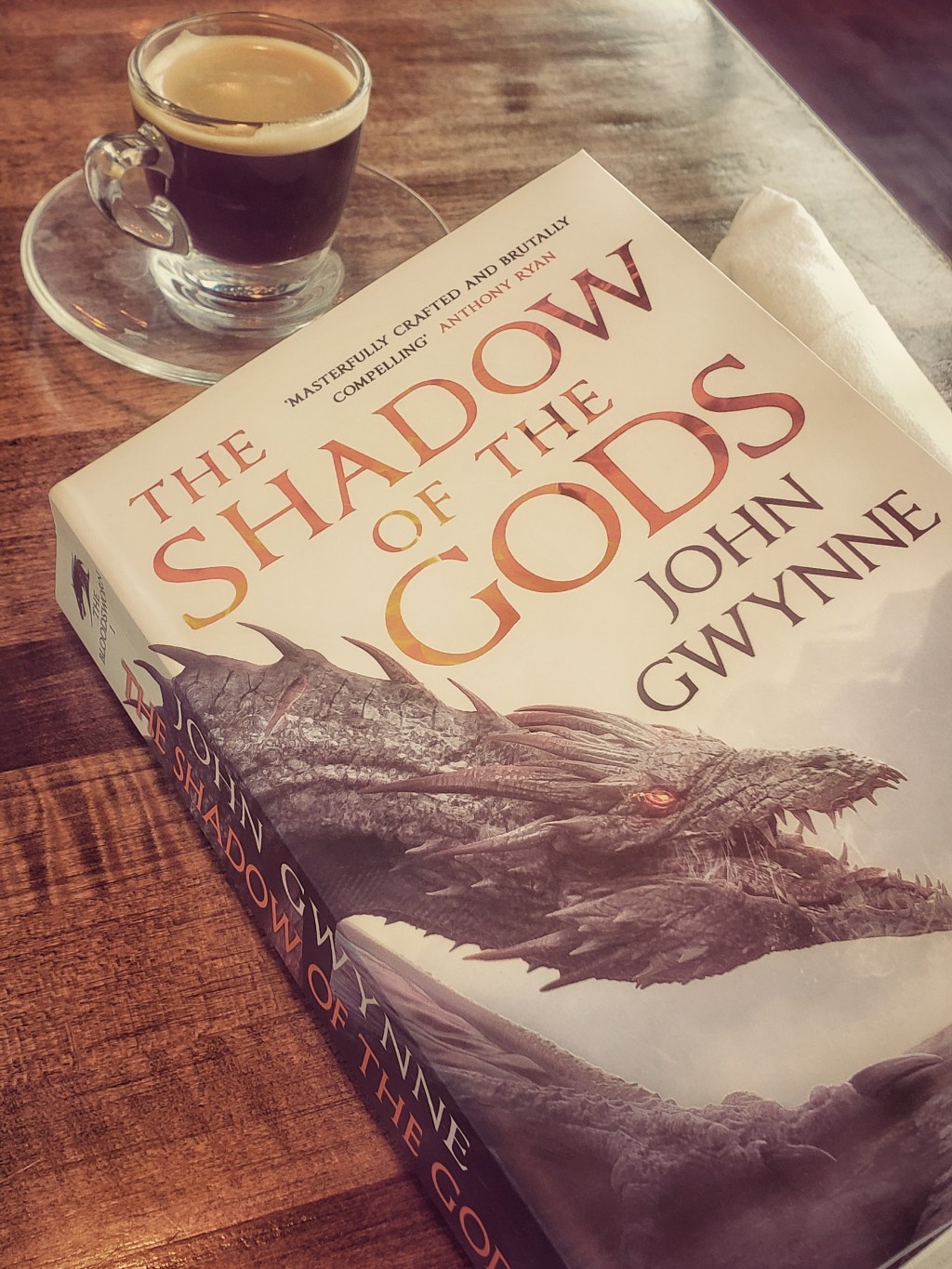
The Shadow of the Gods is the first entry in John Gwynne’s latest series, the “Bloodsworn Saga”. After reading all seven of his prior novels, I went into this 2021 release hoping for the same level of masterful worldbuilding that is his trademark. Now, I can firmly say that he is the greatest contemporary epic fantasy writer out there.
It took me a few chapters to fully fall into the new world of Vigrið (ð being pronounced as the th fricative as in father), but I felt fairly well suited for it because of my background knowledge on his inspiration. You see, John Gwynne’s method of worldbuilding is deeply rooted in the cultures and history of our own world. The Shadow of the Gods, and the Bloodsworn Saga at large, feels immediately like a study in historical northern European cultures. presenting a world populated by analogues to the historical Norse and Germanic peoples. It’s more than just inspired by these cultures – in many ways it feels like Gwynne has directly translated the entire society and placed it within a fantasy world to accommodate his storytelling.
The usual suspects of Norse culture are present, including sea-bound raiders and access to the Afterlife being reserved for those dying an honorable death, weapon in hand. Under the surface though are details that truly inform an understanding of European history. Norse mythology is baked into the lives of Vigrið’s populace, the characters living in a world scarred by the last battle of the gods, Guðfalla – known to us as Ragnarök. The story takes place a few centuries after this great conflict, the society collectively deciding to shun and deride the gods whose battles shattered the land. Living in the gods’ shadows is an act of rebellion in itself, with their lives in the harsh landscape marked by endlessly squabbling jarls and raids by rampaging monsters known as vaesen.
Gwynne takes great effort to show the impact the dead and imprisoned gods have on our characters. Because of the communal hate toward the gods, those tainted with divine blood are treated as worse than the lowest thrall laborers, despite their innate magical powers. Entire cities are constructed out of the bones of the gods. A single glance at the book’s map reveals that the mountain range that bisects Vigrið contains the continent-wide skeleton of Snaka the snake and king of the gods (fans of Jörmungandr rejoice). In the plot, this shows as characters ignorantly repeat the mistakes of their ancestors and failing to respect the real power the dead gods still possess.
But it’s not all sweeping vistas and grand conflicts. John Gwynne has always had a knack for filling epic histories with relatively small heroes caught up in the chaos. In The Shadow of the Gods, Gwynne strategically places characters for us to follow; a huntress seeking her kidnapped son, another a runaway royal fighting in a warband, and the last an escaped thrall seeking vengeance against his slavers.
Their stories are kept largely separate, with only a scant few side characters crossing over. We get to know our main characters in isolation, learning about their varied backgrounds, bonds, and motivations. Gwynne leaves just enough hints to allow readers to connect some of the dots on their own before their storylines begin to converge. Eventually, as all of their destinations start syncing up, it becomes clear that there’s more connecting these characters than just a uniform setting. Indeed, the very last page reveals a major twist stitching up a dangling plot thread that actually made my jaw drop.
I reiterate that John Gwynne is today’s greatest epic fantasy writer. Not because he creates alien and unknowable settings for his stories, but for the opposite – he can create worlds that feel all too familiar to our own. He crafts the most effective heroes I’ve seen that are impossible not to root for. The fact that reading his books rewards intimate knowledge of European history (and Asian history, in his previous books) is just a bonus on top.
To anyone whose blood stirs at the crack of linden-wood shields snapping together in the shield wall or finds wonder in the dazzling waters of fjords, this book is not to be missed.
 Blake is Reading